Ideas & How-Tos
Valentine's Scavenger Hunt for Kids: A Heart Trail at Home
A valentine scavenger hunt for kids can follow paper hearts through familiar rooms to a card-making table or a family note. Draw picture clues for ages 4–5 or choose short riddles for ages 6–9, with each answer leading to the next card. Keep the theme about family and friendship, with cards for classmates, grandparents, or people at home.
Quick Answer
- Choose a checklist for free searching or a clue trail with one finish.
- Pick four or five reachable indoor spots before writing the cards.
- Draw hearts beside recognizable furniture for younger children.
- Keep answers and placement notes on your own route sheet.
- Give siblings turns carrying the card and finding the next one.
- Finish with cards, a book, a small treat, or a family note.
Choose a Checklist or a Clue Trail
A checklist lets the child find things in any order. You might draw three paper cards with a heart, a smiling face, and a flower, then place them around one room. Give the child a matching picture list and ask them to point at each card they find. The drawings stay where you put them until the game ends.
A clue trail has an ordered route. A card about the sofa leads to the sofa, where a different card points somewhere else. Use this format when you want a shared finish. The eight valentine scavenger hunt clues for kids below are choices, so select a few rather than using every destination.
Choose a Moment for the Hunt
On a school day around February 14, leave time to put bags away before handing over the first card. A short route can finish with a note from the family. Keep school cards in a separate pile so no one mistakes a friend's message for the next clue.
On a weekend morning, set the finish beside blank cards for grandparents or other relatives. You can draw the heart decorations while planning the route. If the cards are already made, leave them at the finish to look at together.
For a class-card exchange at home, show visiting children the rooms used for the game. Give a room name when furniture is unfamiliar. Prepare the exchange table first, then keep the trail away from it until the last stop. There is no need to turn individual classmates' cards into puzzles.
Lay Out a Route at Home
Choose a finish and four or five different stops. Try sofa, toy basket, bookshelf, shoe rack, and dining table. The indoor treasure hunt guide has more route examples. Leave kitchen stops out while anyone is cooking, and use surfaces reachable from the floor.
Write the destination and next card's position beside each clue number on a private sheet. Keep the opening card in your hand. If it describes the sofa, the card on the sofa must describe the next destination. Place the ending first and work backward, then walk the route once with the sheet.
Make your own valentine scavenger hunt printable by copying only the selected clue text and drawings onto cards. Answers stay on the parent sheet. Add the room name or a furniture detail if your home has two possible answers. The hearts decorate the paper; you do not need to attach little hearts to every object.
Eight Original Valentine Clues
For a valentine scavenger hunt for preschoolers, choose the four picture options and read any words aloud. The drawings should show your actual furniture. Use clue 5 or clue 6, not both, if the hooks hang above the shoe rack. For the riddles, check that each detail is true in your home before copying it. Each placement below holds the following card, or the finish if that is the last stop.
Four Picture Clues for Ages 4–5
- 1. Heart on a seat. Draw your living room sofa with a large heart above its middle seat and an arrow pointing down. Optional line: “Find the sofa seat below the heart.” Answer: living room sofa. Placement: lay the next card on the middle seat, fully visible without lifting cushions.
- 2. A card among stories. Draw the living room bookshelf with a folded paper card beside the lowest row of books. Put a heart on the drawn card. Optional line: “The books have a paper visitor.” Answer: living room bookshelf. Placement: stand the next card beside books on the lowest reachable shelf.
- 3. Toys get a greeting. Draw the living room toy basket with two toys and a heart card resting across its rim. Optional line: “A greeting waits with the toys.” Answer: living room toy basket. Placement: rest the next card across the top of the toys, with no digging needed.
- 4. Cards for the table. Draw your dining table with chairs around it and a paper heart card at one corner. Point an arrow at the tabletop. Optional line: “Find the corner of the dining table.” Answer: dining table. Placement: set the next card on a cleared edge within reach from the floor.
Four Riddles for Ages 6–9
- 5. Pairs waiting. “I keep outdoor shoes in rows, on low shelves where each pair goes.” Answer: entryway shoe rack. Placement: leave the next card beside a pair on the lowest shelf, clear of the walking path.
- 6. Jacket holders. “On the hallway wall, my low hooks hold jackets by their loops. What am I?” Answer: hallway coat hooks. Placement: hang the next card from a low hook in front of the jackets. Skip this clue if the hooks are too high.
- 7. Clothes awaiting a wash. “In the bedroom, I hold clothes to wash another day. Worn shirts and socks wait inside me, out of the way.” Answer: bedroom laundry basket. Placement: lay the next card on top of the clothes, where it shows without digging.
- 8. Soft bedtime square. “At the head of the bed, I'm soft under your cheek. You rest on me each night; I'm the one that you seek.” Answer: the child's bed pillow. Placement: put the next card on that pillow, reachable from the floor. Name the bed if siblings share the room.
These valentine scavenger hunt riddles can be read aloud. For more verse choices, see the rhyming treasure hunt clues. Keep only one card at each destination during this trail.
Let Siblings Share One Trail
Alternate who carries the current card and who collects the next one. Read the whole clue before the children move. A younger sibling can point to the picture while an older sibling reads, then both walk with you to the answer. Switch jobs at the following stop if both children want a turn.
Keep the finish shared, or label a separate family note for each child. If the children already know the route, change its order before the next round. The around-the-house clue collection offers other indoor destinations if your furniture differs.
Finish With a Card, Treat, or Book
At a card-making table, set out blank paper and pencils beside a finish note. Let each child choose a recipient or draw without writing a message. If you choose a small treat or a book instead, put it at the final spot when the group is nearly there. A note from the family can be the whole ending.
Gather the Paper Afterward
Collect the hunt cards against your route sheet and remove any tape. Keep family and class cards apart from the used clues. Store reusable clue drawings in an envelope, with the route sheet tucked behind them. Clear the table before the next meal.
Sample Pages

Questions
Do you have a Valentine's theme?
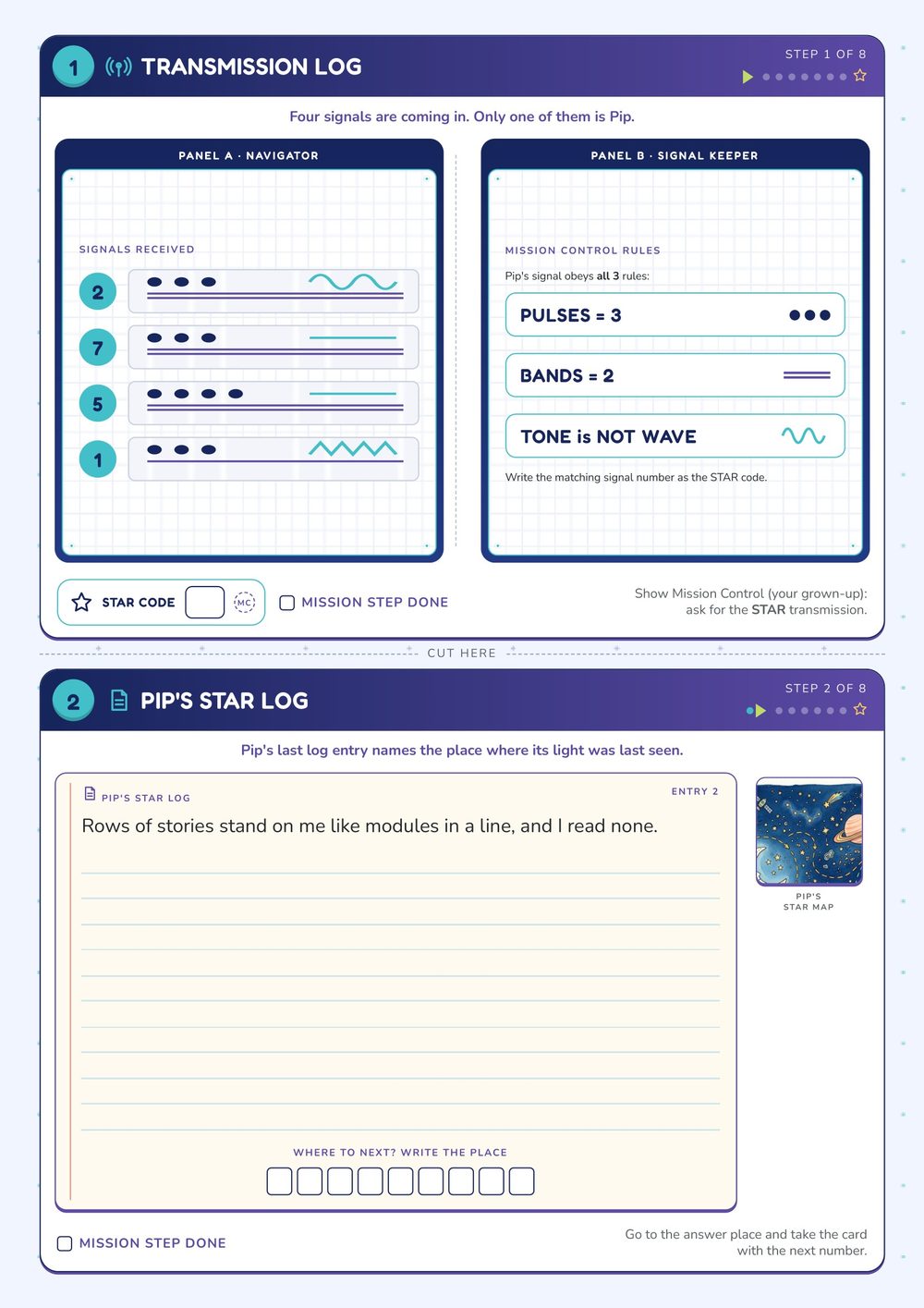
No, Quest Tales has eight themes, and none is Valentine's. They are Pirates, Unicorns, Superheroes, Detective, Space, Enchanted Forest, Dinosaurs, and Magical Kitchen. The clues on this page are DIY ideas, separate from those themes.
Can I make a valentine scavenger hunt printable from this page?
Yes. Copy the chosen riddles into a document, add your own drawings for the picture cards, and print them. Keep answers and placement notes on a separate parent sheet. There is no separate downloadable Valentine's file on this page.
Can I use the trail for a class-card exchange at home?
Yes. Keep the route in familiar rooms and finish at a table with the class cards. Have the children follow one trail, taking turns with each clue. Keep cards meant for classmates separate from the hunt cards.
What if I want a finish without sweets?
Put out a book, blank cards and pencils, or a note from the family. Add a finish card so the child knows the trail is complete. Choose something that fits the space you have cleared.