Ideas & How-Tos
Scavenger Hunt Clues for Kids Around the House (With Answers)
Scavenger hunt clues for kids around the house work best when each clue names one familiar, reachable place. Choose a few of the twenty options below, write the child-facing words or drawings on cards, and keep the answers and placement notes on your own route sheet. Hand over the first card and let each answer lead to the next.
Quick Answer
- Pick four or five safe spots from rooms you want the child to visit.
- Use picture clues or a short spoken line for ages 4–5.
- Use riddles with one fair answer for ages 6–9.
- Write the answer and the following card's position on a private sheet.
- Place the finish first, then work backward through the route.
- Keep the first card with you until play begins.
Living Room Clues
These five living room choices are alternatives. Pick only the furniture your home has. For a picture card, draw the actual shape or color of the object, then read any line aloud. The answer and placement sentence are for you, not the child.
- 1. Ages 4–5. Picture idea: draw your sofa with its two arms and one cushion marked by a dot. Child-facing line: “Find the long soft seat.” Answer: sofa. Place the following card on the marked cushion, fully visible.
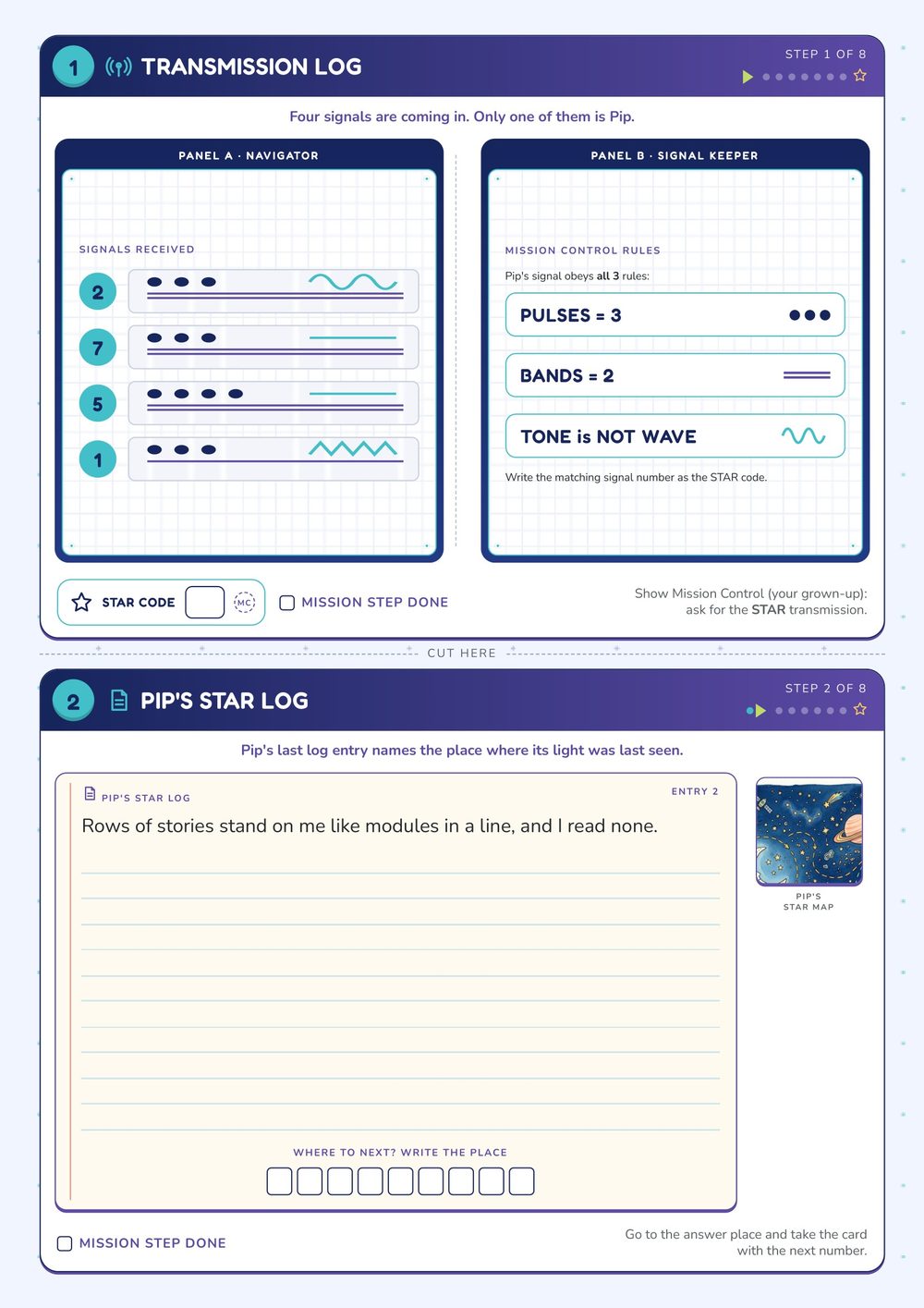
- 2. Ages 6–9. “My rows are full of spines, but not one of them belongs to a back. Find the low row where stories wait.” Answer: bookshelf. Place the following card beside books on a low shelf, without moving the books.
- 3. Ages 4–5. Picture idea: draw the handles of your toy basket and two familiar toys peeking over the edge. Answer: toy basket. Lay the following card across the top so nothing must be emptied.
- 4. Ages 6–9. “This is the quiet reading corner with its own cushion or small chair. A book can rest here while someone listens.” Answer: reading nook. If your reading spot is the sofa, use clue 1 or 5 instead. Put the following card on its cushion or low chair seat.
- 5. Ages 6–9. “I am soft enough for a head, but I wait on the living room sofa, not a bed.” Answer: sofa pillow. Set the following card beside that pillow on the sofa seat, with an edge showing.
Kitchen and Dining Clues
Skip kitchen stops while anyone is cooking. Keep these cards on reachable outside surfaces. The refrigerator door stays closed for this game. Clear dishes and drinks from the table before you place paper there.
- 6. Ages 4–5. Picture idea: draw the refrigerator as a tall rectangle with its handle and a card on the outside. Answer: fridge door. Fix the following card to the outside at child height with a magnet.
- 7. Ages 6–9. “Plates gather on my top, and chairs wait around me. Find me where your family eats.” Answer: dining table. Place the following card on a cleared edge of the table.
- 8. Ages 4–5. Picture idea: draw one kitchen chair with its back, legs, and a big star on the seat. Answer: kitchen chair. Lay the following card flat on that chair's seat.
- 9. Ages 6–9. “I have a back and four legs, yet I never take a step. Find me tucked in at the kitchen table.” Answer: kitchen chair. Pull one chair slightly out from the table and lay the following card on its seat.
Bedroom Clues
Choose the child's own bedroom so “bed” or “pillow” cannot mean several rooms. If two beds share the room, add a color or blanket detail to the card. Keep cards on top of bedding rather than hidden deep inside it.
- 10. Ages 4–5. Picture idea: draw the child's bed with its usual blanket and an arrow to the foot. Answer: bed. Place the following card on top of the blanket at the foot.
- 11. Ages 6–9. “I wait at the top of your bed and hold your head when it is time to rest.” Answer: bed pillow. Place the following card on top of that pillow.
- 12. Ages 4–5. Picture idea: draw the bedroom's low bookshelf with three upright books and one striped book. Answer: bedroom bookshelf. Place the following card beside the striped book on a reachable shelf.
- 13. Ages 6–9. “Toys return to this open place after their adventures. Look near the handles on its rim.” Answer: bedroom toy basket. Rest the following card on top of the toys near the rim.
Bathroom Clues
Use a dry bathtub only. Keep the card away from taps and wet surfaces. If the room is in use, choose another stop rather than asking the child to wait at its door.
- 14. Ages 4–5. Picture idea: draw the empty bathtub and one blue dot on its dry rim. Answer: bathtub. Place the following card on the dry, reachable rim, not in the basin.
- 15. Ages 6–9. “I am a place for a splash, but today I am empty and dry. My edge holds the next message.” Answer: bathtub. Put the following card on its dry rim within easy reach.
- 16. Ages 4–5. Picture idea: draw the bathroom's laundry basket with a towel lying across its top. Answer: laundry basket. Place the following card on the towel, where it is visible.
Hallway and Entry Clues
Keep the entry clear while children move between rooms. An indoor mat, low hooks, and a shoe rack offer clear targets without sending anyone outside or up a step.
- 17. Ages 6–9. “Shoes line up on my shelves before they walk out the door.” Answer: shoe rack. Place the following card on a low shelf beside a pair of shoes.
- 18. Ages 4–5. Picture idea: draw the coat hooks and one familiar jacket hanging from a low hook. Answer: coat hooks. Hang the following card from that low hook, beside the jacket.
- 19. Ages 6–9. “I lie flat just inside the front door and catch the dirt that shoes bring home.” Answer: front-door mat. Slide the following card partly under the indoor mat's near edge, with half the card showing and the mat flat.
- 20. Ages 4–5. Picture idea: draw the small hallway table with one object the child knows on top. Answer: hallway table. Set the following card next to that object on a clear corner.
Turn Separate Clues Into One Trail
A clue describes the destination, not the place where its own card sits. If your first card describes the sofa, place card two on the sofa. Card two might describe the kitchen chair; card three then waits on that chair. Keep writing the chain until the last card leads to a finish note or small gift. The numbers above organize the examples by room, not by playing order.
Make a private list with three columns: card number, answer, and where the next card sits. Put the finish in place first. Then lay each card in reverse order. Keep the opening card in your hand. Walk the route once before you start and check that no later card is visible at a stop the child visits early. If you reuse a spot, hold its later card until the first visit is over.
Try a five-stop route such as sofa, fridge door, bed, shoe rack, and dining table. The next card always waits on the named surface, while the child-facing card names the following place. The indoor treasure hunt guide has more route examples. For a younger child, the picture clue guide shows another approach.
Adjust the Difficulty Without Losing the Answer
For a younger child, use a drawing of the exact furniture. Add its familiar color or a blanket pattern, and read a short line aloud if you use words. Put the next card in plain sight once the child reaches the right object. If the child points to the correct place, let that count as solving it.
For an older child, leave out the object's name and use two true facts instead. “I catch dirt” and “I lie inside the front door” point to the mat more clearly than a vague rhyme about the floor. If two objects fit, add the room or a unique detail. More searching should come from the clue, not from hiding paper where it cannot be found.
Write One of Your Own
Start with an object you actually have. Write down what it does, then where it stands. A laundry basket holds clothes and sits beside the bedroom door, for example. Turn those facts into one short line: “I hold the clothes beside the bedroom door.” Check that no other basket in your home fits. Then mark the answer and exact placement on your private sheet.
You can copy your chosen cards onto scrap paper or print the text and cut it into cards. Keep the answer sheet out of the child's view. Once the finish is found, collect the used cards and check the route sheet for one left behind. For a set built around rhymes, see these rhyming treasure hunt clues.
Sample Pages

Questions
How many clues should I use at home?
Start with four or five of these DIY clues. Add another if the route has enough distinct, reachable spots. A short trail with one clear destination per card is easier to place and follow than twenty cards at once.
How can I make clues harder for older kids?
Remove an obvious word, add one truthful detail about what the object does, or ask the child to choose between two possible rooms. Keep one fair answer. Read the revised clue yourself before hiding it.
Can I reuse these clues?
Yes. You can copy them onto your own cards and use them again at home. Change the route and the details that describe your furniture so the answers still point to the right places.
What if the child is stuck?
Read the clue aloud again and point to its strongest detail. If the child still cannot choose a spot, name the room or walk there together. Put the next card where it can be seen once the answer is found.