Ideas & How-Tos
Free Printable Scavenger Hunt for Kids: Two Ways to Start Today
A free printable scavenger hunt for kids can be a finished PDF sent to your inbox or a set of cards you copy from this page. For the finished version, choose a free sample quest and print the emailed files. For a hunt you can shape around your own rooms, copy the checklist or clues below onto paper.
Quick Answer
- Get the free sample quest by email if you want a complete PDF.
- Choose Pirates or Space and the 4–5 or 6–9 age band on the sample form.
- For a DIY printable, copy the checklist or clue cards below into a document.
- Use safe indoor spots that a child can reach without climbing.
- Put answers on your private route sheet, away from the child's cards.
- Print on ordinary letter paper and cut along your own dashed lines.
Way One: A Complete Sample Quest by Email
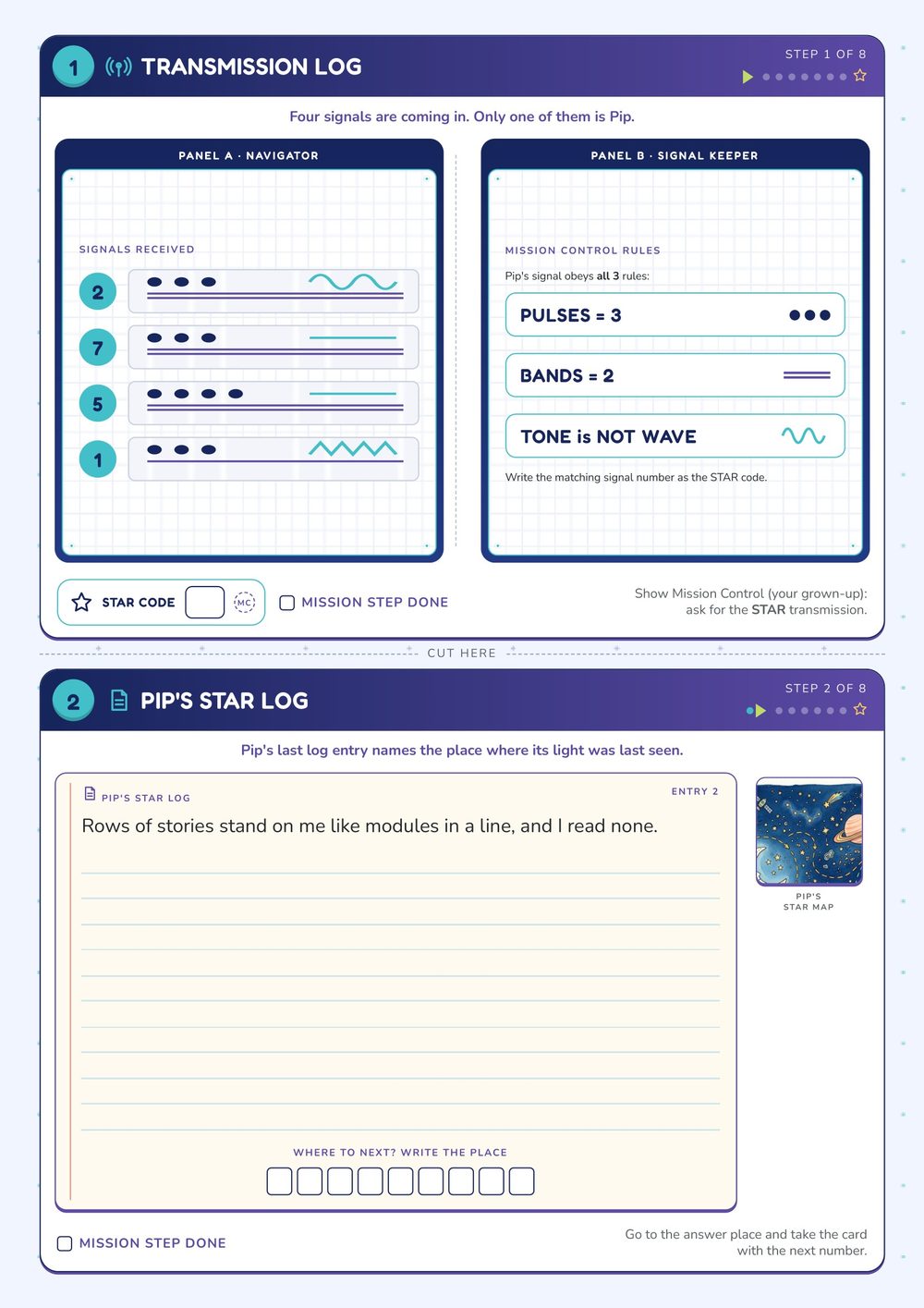
The free sample page lets you choose Pirates or Space. The sample is a complete Quest Tales PDF sent by email, with a parent page, clues and a finale. It comes in full-color and ink-saver print versions. You can select an age band of 4–5 or 6–9; the sample uses the names Finn or Nova and four common hiding places. There is one free sample per email address per day, and the box for occasional ideas by email is optional. The sample pages shown below come from a personalized space quest for age 8. The free samples are written for age 5 or age 7; both samples for 6–9 (space and pirates) use that design, and the two samples for 4–5 use the classic card design.
The rest of this page gives you words and drawing directions to paste into a document yourself. There is no file to download from this article. If the sofa in your house looks different from a generic drawing, your own quick sketch will be a better clue.
Way Two: A Copyable Indoor Checklist
For a checklist hunt, the child finds items in any order and ticks each line. Copy the twelve lines below into a document, leaving a square before each one. For ages 4–5, draw a small picture beside every line and read the list aloud. Point out which rooms are in bounds before the child begins. An item can stay where it is; finding and pointing is enough.
- A sofa cushion
- A pillow on a bed
- A book on a low bookshelf
- A toy in a basket
- A chair at the dining table
- A coat on a hook
- A pair of shoes on a rack
- The indoor front-door mat
- A towel beside a dry bathtub
- A card on the outside of the fridge door
- A clean item in a laundry basket
- A book or cushion in a reading nook
These are words to copy, not a fixed set of objects that every home has. Cross out any missing item and draw something familiar in its place. Keep the search in rooms where an adult can see the group. Nothing on the list asks a child to open a fridge, reach above a shelf, or look inside a machine.
Copyable Clue Cards for Ages 4–5
A trail works differently from a checklist. Each card points to one spot, and the following card waits at that answer. Copy only the picture idea and the optional spoken line onto each child's card. Keep the answers and placement notes from the Parent Answer and Placement Sheet below on a separate parent sheet. Choose the cards for spots you have, and order them so a card never points back to where it is lying.
- Card 1. Draw a sofa with two cushions and a large dot on one seat. Say, “Find the seat with cushions.”
- Card 2. Draw a low bookshelf with three upright books and a dot beside them. Say, “Look beside these books.”
- Card 3. Draw a toy basket with two toys peeking over its rim. Say, “Look on top of the toys.”
- Card 4. Draw the child's bed and a pillow with a dot beside it. Say, “Look by the pillow.”
- Card 5. Draw a dining table with one chair and a dot on its cleared corner. Say, “Find this table corner.”
- Card 6. Draw a row of coat hooks with a jacket and a dot below it. Say, “Look near the hanging coat.”
Copyable Riddle Cards for Ages 6–9
Copy one riddle per card. A child can read it or you can read it aloud. If your home has two possible answers, add the room name or a color that makes the intended place clear before printing. Keep the answers on your parent sheet.
- Card 7. “I am by the door, and shoes line up on my shelves after a walk.”
- Card 8. “Chairs surround me in the dining room. Plates visit my top at dinner, then leave when everyone is done.”
- Card 9. “Milk and butter stay cold behind me. Look on my outside, where magnets hold notes.”
- Card 10. “Clean shirts and towels ride in my open basket after washing. Look where you keep the clean laundry.”
- Card 11. “I lie flat where shoes first step indoors. Keep the door closed while you look.”
- Card 12. “I am the corner with a book and a cushion, ready when the room grows quiet.”
Parent Answer and Placement Sheet
Copy this section to another page and keep it out of the child's stack. Each placement is for the next card on your chosen route. The first card stays in your hand. The final answer can hold a finish note instead of another card. Use only the cards that match real places in your home.
- Card 1 answer: sofa. Place the next card on the marked seat, fully visible.
- Card 2 answer: bookshelf. Place the next card beside books on a low, reachable shelf.
- Card 3 answer: toy basket. Set the next card on top of the toys, with an edge showing.
- Card 4 answer: bed. Place the next card beside the pillow, on top of the bed.
- Card 5 answer: dining table. Lay the next card on a cleared corner, away from dishes.
- Card 6 answer: coat hooks. Place the next card below a low hook, within reach. Skip this card if all the hooks are above the child's reach.
- Card 7 answer: shoe rack. Put the next card on a low shelf beside the shoes.
- Card 8 answer: dining table. Place the next card on a cleared edge of the table.
- Card 9 answer: fridge door. Attach the next card to the outside at child height.
- Card 10 answer: laundry basket. Set the next card on top of clean laundry.
- Card 11 answer: front-door mat. Put the next card on the indoor mat with the door shut.
- Card 12 answer: reading nook. Set the next card on its cushion or beside its book.
Put the Cards on Letter Paper
In your document, make a table with three card boxes across each row. Let each box hold a short clue, a large drawing space if needed, and a card number in one corner. Leave enough margin for the printer. Add dashed cut lines between the boxes, then print and cut. Put the answer list on a separate parent sheet, not on the reverse of the cards.
A six-card set needs two rows. Give the first card by hand. Put the card it points to at that answer, and continue until the final clue leads to a finish note or a small item you chose. Placing cards from the finish backward makes it easier to keep the sequence straight. Walk the route once before play and remove any card that could be found early.
For another printable indoor route, see the indoor treasure hunt guide. It shows how to plan four or five stops and place cards from the finish backward.
Sample Pages


Questions
Is the printable really free?
Yes. The free sample is a complete PDF quest sent by email, with full-color and ink-saver files. You choose Pirates or Space and one of two age bands. The email signup for occasional ideas is an optional, separate checkbox. One free sample is available per email address per day.
What do I need to print the DIY cards?
Copy the checklist or clue text from this page into a document, then use ordinary letter paper and a printer. A pencil and scissors help you mark the route and cut out cards. You can draw the picture cues by hand before play.
Can I print the sample more than once?
Yes, for your own home or one private celebration. Keep the files for that use and print as many paper copies as your group needs.
Which age should I choose?
For the DIY set, use the picture checklist or six simple cards for ages 4–5. Use the six written riddles for ages 6–9. You can read any card aloud and shorten either trail to fit your group. On the sample form, the 4–5 sample is written for age 5 and the 6–9 sample for age 7.