Ideas & How-Tos
Space Treasure Hunt for Kids: Clues to the Gift Planet, or a Home Beacon Mission
A space treasure hunt for kids uses clues to turn home furniture into planets on a route to a hidden gift. Start at home base, count down, and follow pictures for ages 4–5 or riddles for ages 6–9. The DIY route on this page ends at a gift planet. The sample pages further down come from two Quest Tales PDFs: four sheets for age 8, The Home Beacon Mission, where the same kind of furniture becomes the stops on the rescue of a lost star, and two sheets for age 5, Mission to the Gift Planet. Which story a printed quest tells at each age is explained near the end of the page.
Quick Answer
- Turn four or five furniture spots into pretend planets.
- Plan five or six stops for ages 4–5, or seven or eight for ages 6–9.
- Gather a printer, paper, scissors, and a gift for the final landing.
- Keep the first clue at home base for your handoff.
- Use a short spoken countdown to begin.
- For ages 7–9, you can turn the finish into a dark beacon that three collected words switch back on.
- In a Quest Tales PDF, ages 4–6 fly to the gift planet and ages 7–9 repair the Home Beacon.
Make a Planet-Hopping Route
Use the home as your pretend solar system. The living room might contain the sofa planet and the dining-table planet; the bedroom might hold the final destination. You can have several planets in one room. The distance between them matters less than a clear clue to the next piece of furniture.
Choose the gift planet before drawing the rest. Pick somewhere that holds the package comfortably and is easy to reach alongside the child. Then choose three or four other places you want on the trail. Any room you would rather keep quiet simply stays off the map from the beginning.
Draw each chosen item inside a large circle for your DIY planet cards. A bookshelf inside a circle is still visibly a bookshelf. You can add a few stars outside the circle, with plenty of white space around the furniture. Avoid filling the center with decoration that hides the destination.
Use the actual place names on your private route sheet. If you add a planet nickname, write it beside the real furniture name. The child should not have to guess that a made-up word means the sofa before trying the clue. Say the match during the opening if you plan to use both names.
Arrange the Cards for Return Visits
A seven-stop route can visit four or five places by returning to some after another stop. Put only the next available card at a location. Keep its later card with you and set it down after the first visit there has finished. This gives each landing one clear find.
Place the gift and final clue first, then work backward along your list. At each planet, hide the card that points to the next one. The first travel clue stays at home base in your hand. Walk the finished route once, checking that the words on each card match the next place on your list.
If two people are preparing the hunt, give one person the route sheet and the other the cards in order. Read each destination aloud as you place it. It is easy to mix up the location pictured on a card with the location where that card belongs.
Eight Original Space Clues
These DIY choices are written for this page. Use the ones that match your four or five places, and choose another example for a return visit. The destination labels and placement notes belong on your sheet, away from the child's clue text.
Picture Clues for Ages 4–5
- 1. Dining table, ages 4–5. Picture idea: draw your table inside a planet circle, with its chairs clearly visible. Optional line: “Land beside the table with the chairs.” Leave the next card flat on a cleared table edge where the child can reach it.
- 2. Bookshelf, ages 4–5. Picture idea: draw the low bookshelf with a small ringed planet above the row of books. Optional line: “The book planet is our next landing.” Put the next card at the front of the low shelf, without hiding it behind the books.
- 3. Bed, ages 4–5. Picture idea: show the bed inside a circle and a crescent moon above its headboard. Optional line: “Visit the bed under the drawing's moon.” Place the next card on the blanket near the side. The moon stays on the paper.
- 4. Front-door mat, ages 4–5. Picture idea: draw the indoor mat as a rectangle inside a starry circle, with the home's entrance behind it. Optional line: “The indoor mat is the landing pad.” Slip the next card under a corner. Keep the drawing specific to the mat inside your home.
Riddle Clues for Ages 6–9
- 5. Fridge, ages 6–9. “Our pretend planet keeps its milk cold even when the kitchen is warm. Find its outside front.” Answer: fridge. Attach the next card at the child's height. The front surface is the whole search area for this stop.
- 6. Toy basket, ages 6–9. “Small toys share this open home after their daily adventures. Which basket planet holds them?” Answer: toy basket. Place the card on top, with enough of it visible to pick up. Use the basket that appears on your route sheet.
- 7. Sofa, ages 6–9. “Several astronauts could sit together on my long cushioned seat, with one back behind them.” Answer: sofa. Leave the next card on a seat near one end. The astronauts are part of the story, so a row of toy figures is optional.
- 8. Dining table, ages 6–9. “At this planet, breakfast dishes stand above the chairs. Find the broad top where meals are served.” Answer: dining table. Set the next card on a cleared corner. This can be a return to the table after another planet visit.
Start With a Countdown at Home Base
Gather the child or group where you will hand over the first clue. Explain that the gift planet is the final landing and each card gives directions to one stop. For a party, tell everyone who carries the first card and how you will change turns later.
Count down from five in your usual speaking voice, then give the card to the child. The countdown begins the story; it does not measure how quickly anyone must finish. A small wave or a pretend button press can mark the launch if the child wants an action.
Bright rooms work best here: the pictures are easier to spot and nobody bumps a planet in the dark, so the space setting comes from the paper circles rather than the lighting. If the child wants a fresh countdown at every planet, save it for the moment everyone has arrived and heard the next clue.
Arrive at the Gift Planet
Write a short DIY finish sheet saying the crew has reached the gift planet. Put it beside the package and read it when the child arrives. Make this the last landing, with the gift ready to open rather than another destination to decode.
If the final planet was visited earlier, hold the package back until that stop is finished. Choose somewhere that lets you place it while the child is at another destination. Your route sheet can include a reminder beside the earlier visit.
Before launch, clear a corner of the table and tuck the scissors away with the rest of mission control. Carry each used card with you so the planets do not fill up with old directions. After the final landing, the paper circles and any cards you kept for later go into one pile, and home base turns back into an ordinary table as soon as the crew is done.
Run It as a Beacon Mission for Ages 7–9
If your child is 7–9 and enjoys a job to report on, keep the same route and change the story of the finish. Tell them at home base that a beacon which guides lost stars home has gone dark, and that the gift waits beside it. Call yourself Mission Control and mark three cards along the route as report cards. When the child finds one, they come back to Mission Control, report which place it points to, and only then go on.
Write one word on each report card, such as STAR, MOON, and PLANET, and ask for all three words at the last stop before the package is opened. Your finish sheet then says the beacon is back on. This keeps the shape of the Quest Tales mission for ages 7–9, described below, without its puzzle cards.
What a Quest Tales Space Quest Contains, by Age
A printed Quest Tales quest is separate from the DIY route above. You enter your child's name, age, and four or five places in your home, and the PDF arrives by email with its own clue cards for those places. The Space theme tells one of two stories, chosen by the age on the order form.
Ages 4–6: Mission to the Gift Planet
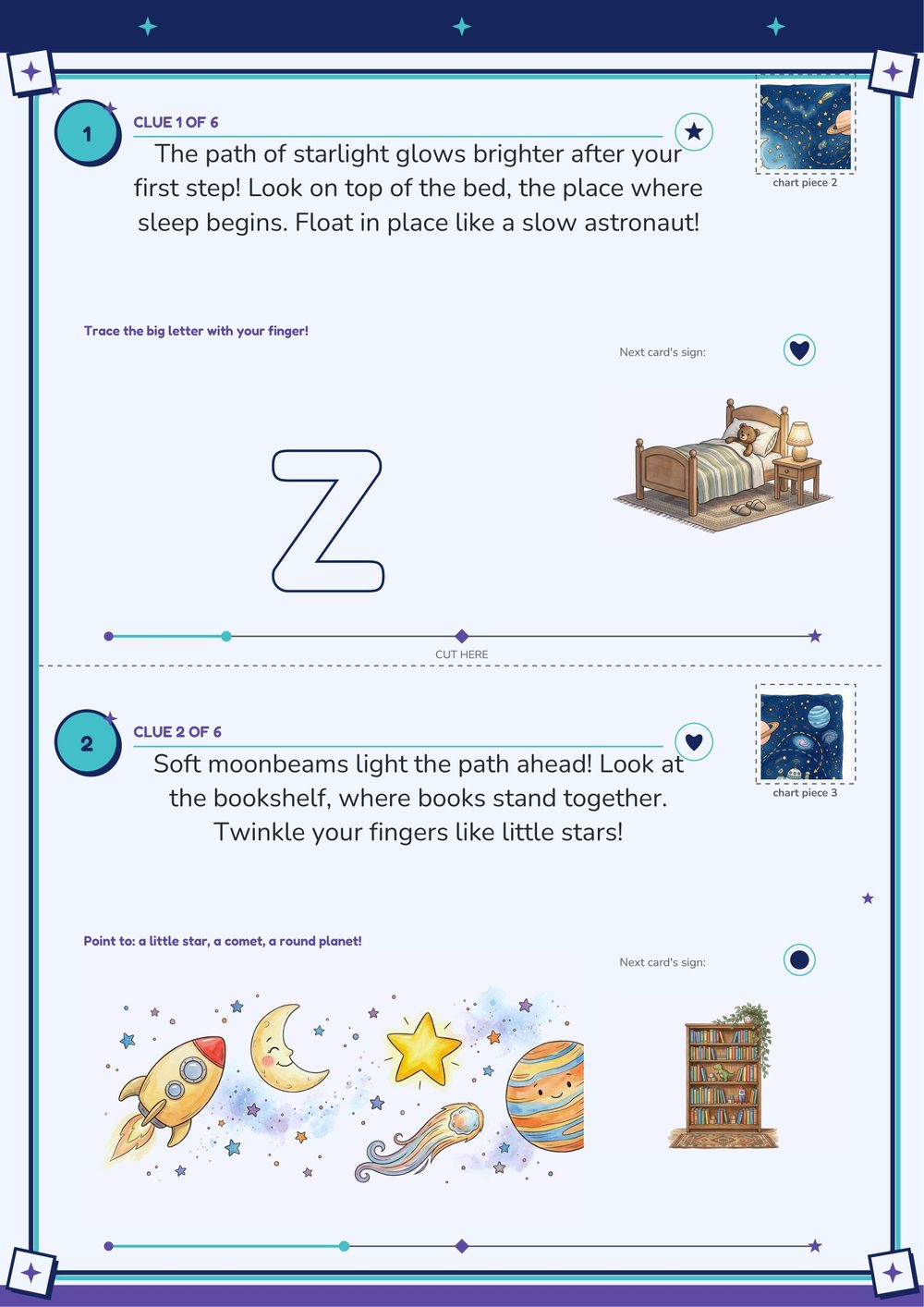
The cover reads Mission to the Gift Planet. The opening message comes from Luna the moon-bird: a little star rolled away before the star-party, and your child sets out to bring it home. Partway along, a soft humming turns out to be Cosmo, a little comet humming to the star. Each clue card shows a small drawing of the next piece of furniture. For ages 4–5 the clue tells the child in plain words where to go and adds a short action to do on the spot, such as twinkling fingers like little stars or slow moon-steps in place.
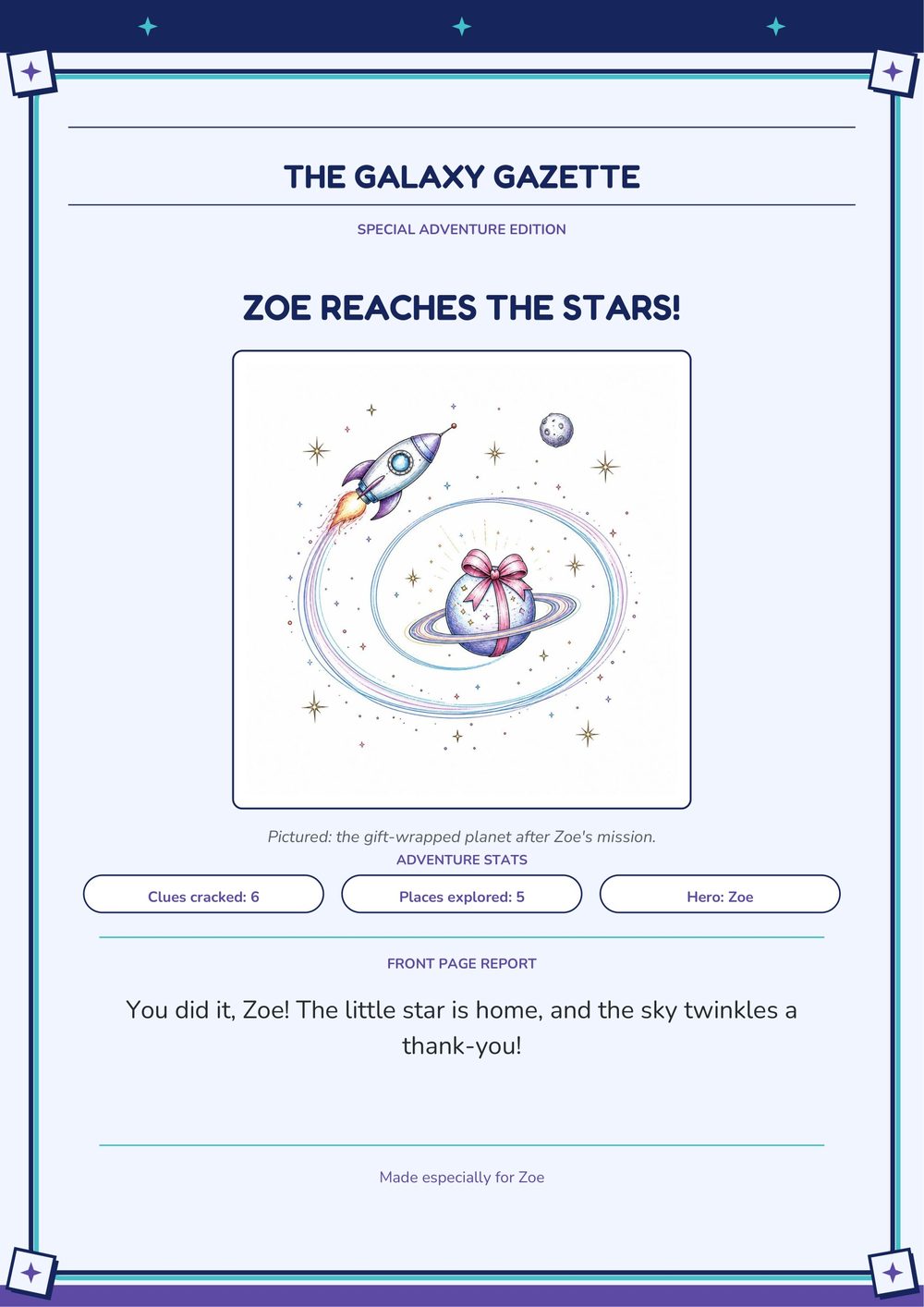
Ages 4–5 get five or six cards, collect pieces of a night-sky chart along the way, and lay them out on a chart sheet at the end. Age 6 gets seven or eight cards without the actions, each with a short clue for its stop that either names the place or describes it, and no chart sheet. The finale is a front page of The Galaxy Gazette with a drawing of a rocket circling a ringed planet tied with a bow, followed by a certificate: Star Helper of the Night Sky for ages 4–5, Navigator of the Star Mission at 6. The sample pages below include a clue sheet and the Galaxy Gazette finale from this quest for age 5.
Ages 7–9: The Home Beacon Mission
The cover reads The Home Beacon Mission. The story opens with an incoming transmission from Luna at Mission Control: a little star called Pip has lost the way home, and the Home Beacon that guides stars home has gone dark. Your child is the Navigator, and you are Mission Control. Seven cards lead through your home when you chose four places, eight when you chose five.
Three of the cards are module tasks. On the Transmission Log, the child picks the one signal that obeys every rule and earns the STAR code. On the Navigation Chart, a flight plan is followed square by square across a star chart to the landing square, which gives the MOON code. On the Beacon Control Panel, a short list of rules points to the one switch that shows the PLANET code. After each module card the child brings the code to you, and you read the reply from the Mission Control Script on the last sheet, which leads to the next place.
The other cards carry the word clues, each dressed as a story object: Pip's star log, an asteroid warning, a mirror message printed upside down, and, when you chose five places, a landing pad. The asteroid warning holds a riddle at 7, a scrambled word at 8, and a number code with its decoder at 9. The last card is the Beacon Key, where the three codes are copied in order and the beacon comes back online. The finale is a Galaxy Gazette front page with a line drawing of the beacon lit again and Pip back in the sky, then a certificate with a medal to cut out. Two children can share the module cards as Navigator and Signal Keeper, each reading one panel.
The clues on this page are DIY ideas, separate from the clues in a Quest Tales PDF, which are written for the places you select on the order form.
Sample Pages


See the Space quest on the main page
Questions
How many planets should I include?
Choose four or five home spots for your DIY planets. Plan five or six stops for ages 4–5, or seven or eight for ages 6–9, using return visits where needed. Keep later cards with you until the earlier visit is over.
Does a space hunt work in a small apartment?
Your DIY planets can be furniture spots in one or two rooms. A table and sofa can be different destinations without being far apart. Use the furniture pictures or names to make each landing place clear.
Do I need a rocket model or space decorations?
For this DIY version, a spoken countdown and paper planet drawings can set the scene. Use a printer, paper, scissors, and your chosen gift. A rocket model or costume is optional.
Are the space clues suitable for a child who does not read yet?
Choose the picture examples for ages 4–5 and read the opening and optional lines aloud. Point out the matching furniture before starting if needed. The riddle examples are labeled for ages 6–9.
Which space story does a Quest Tales quest tell?
It depends on the age you enter on the order form. Ages 4–6 receive Mission to the Gift Planet, with Luna the moon-bird and a little star to bring home. Ages 7–9 receive The Home Beacon Mission, with Pip the lost star, three module tasks, and a Mission Control Script for the parent. Both use the four or five home places you choose.