Ideas & How-Tos
Pirate Treasure Hunt at Home: Map, Clues and the Captain's Lost Treasure
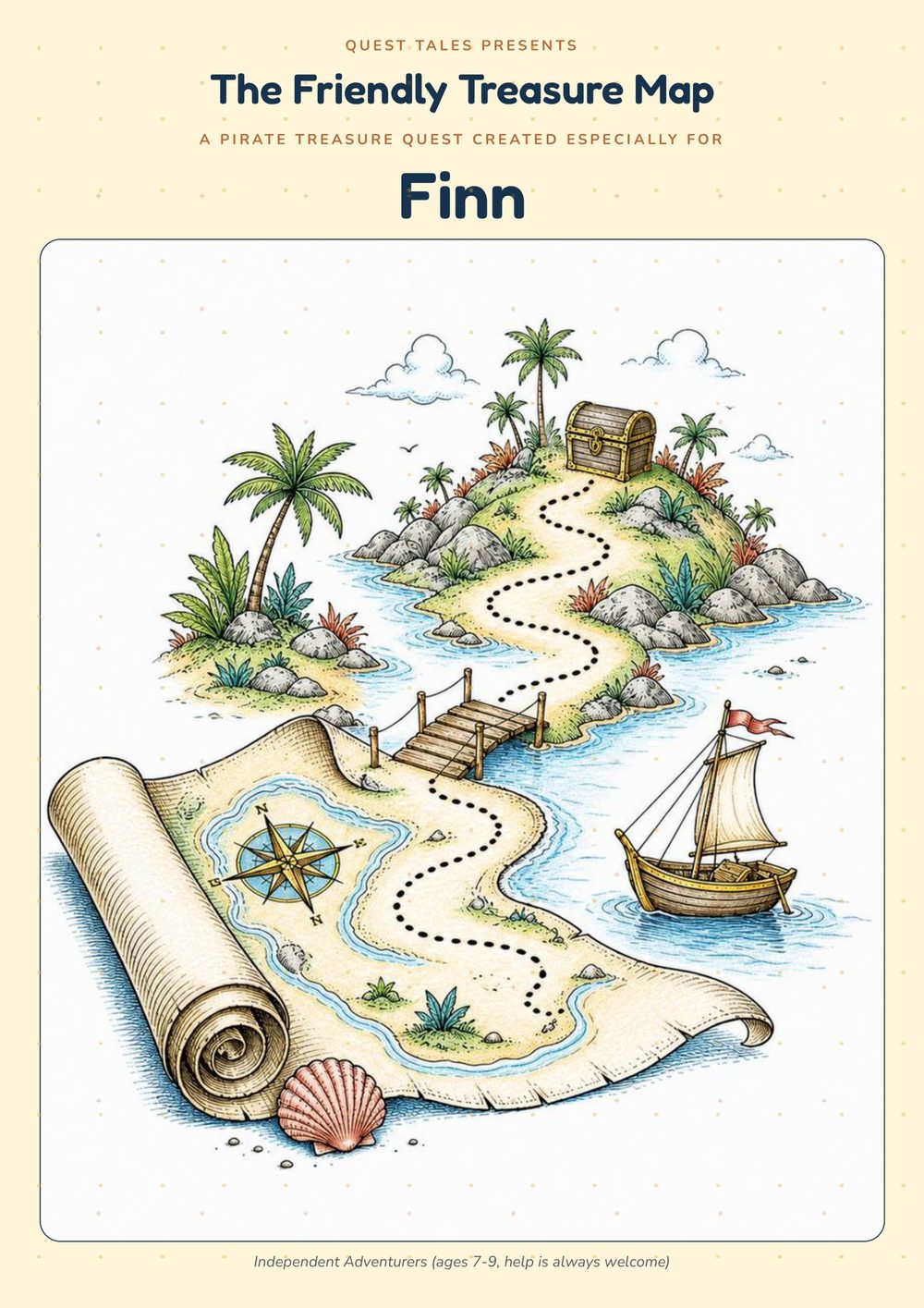
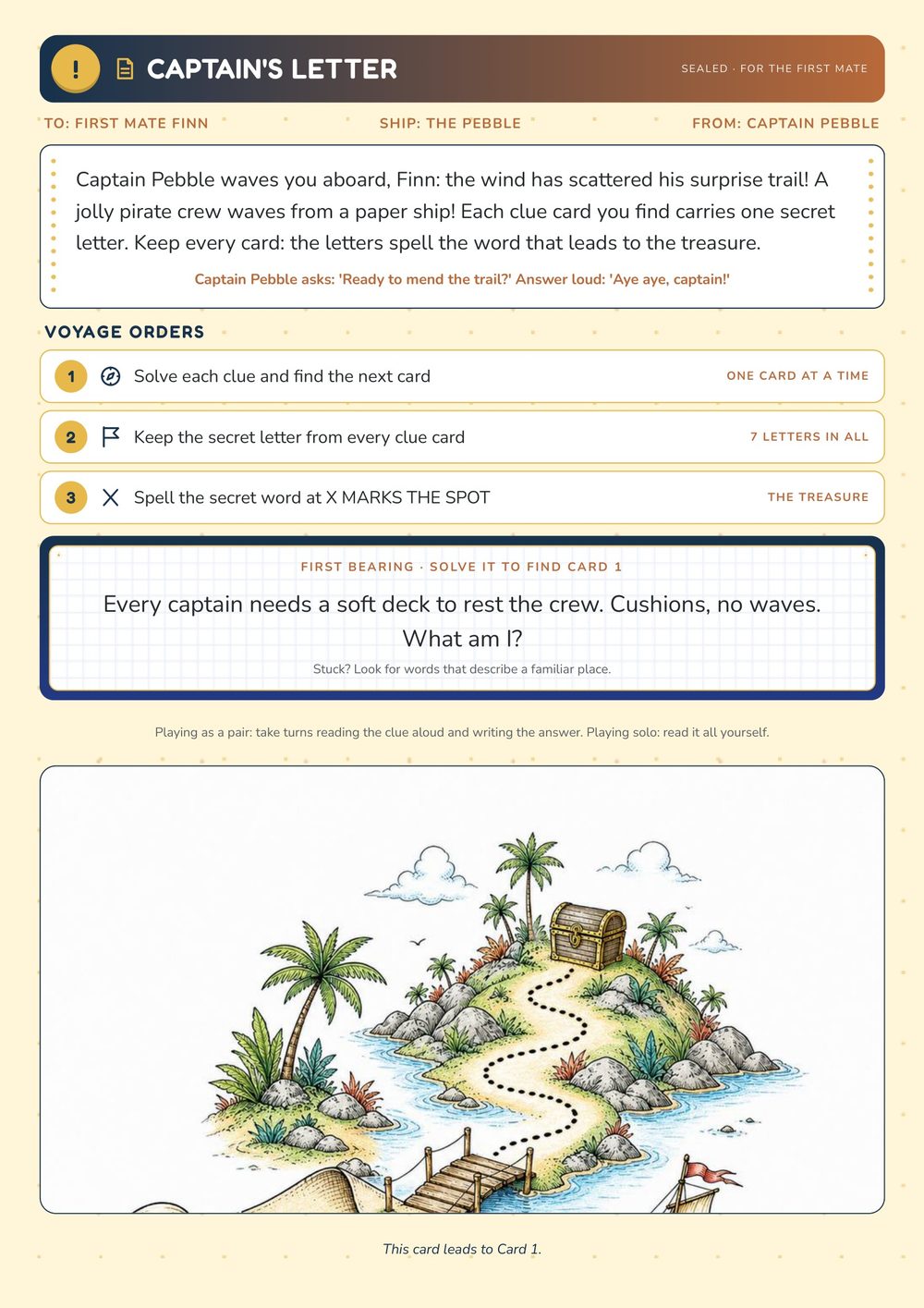
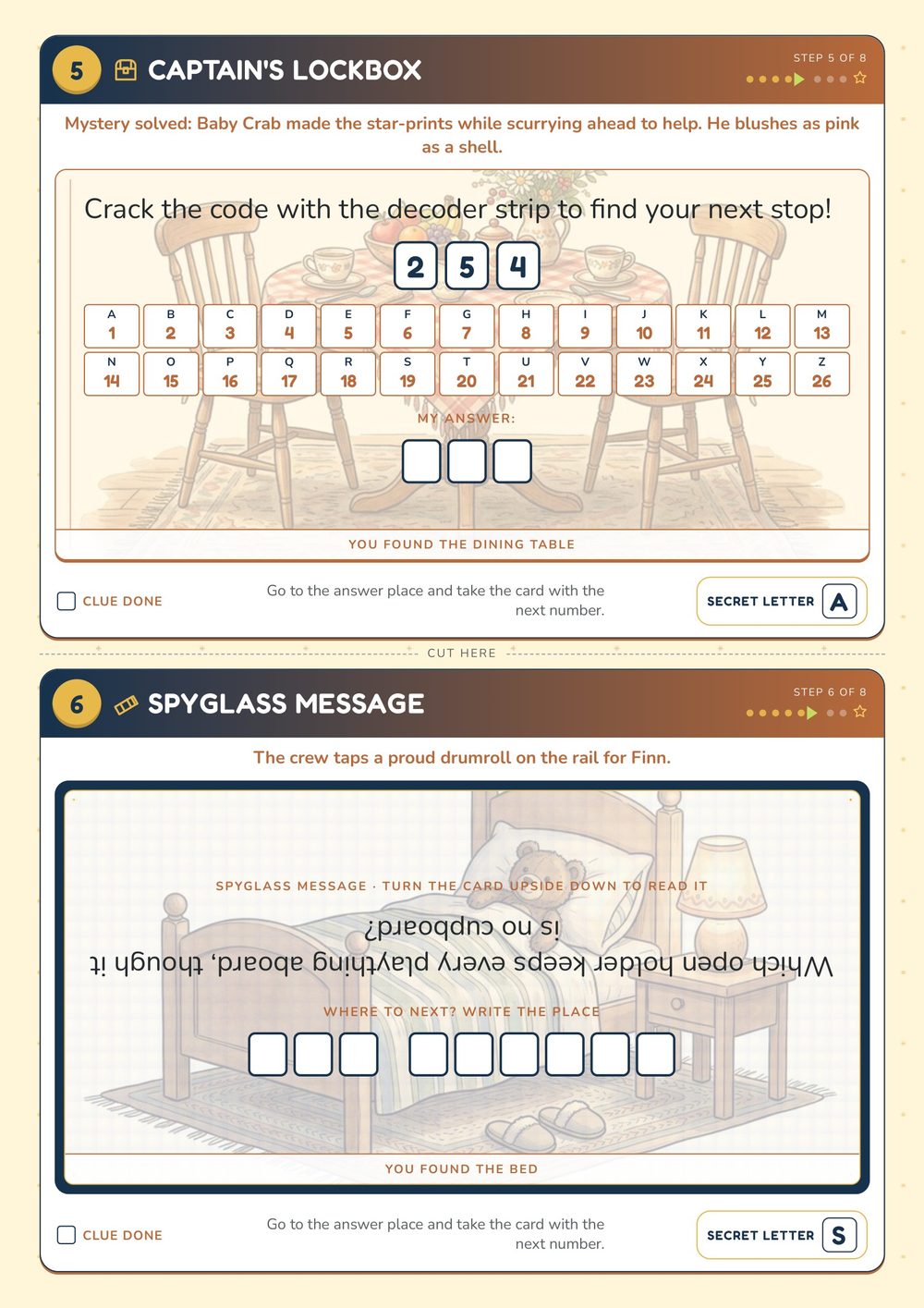
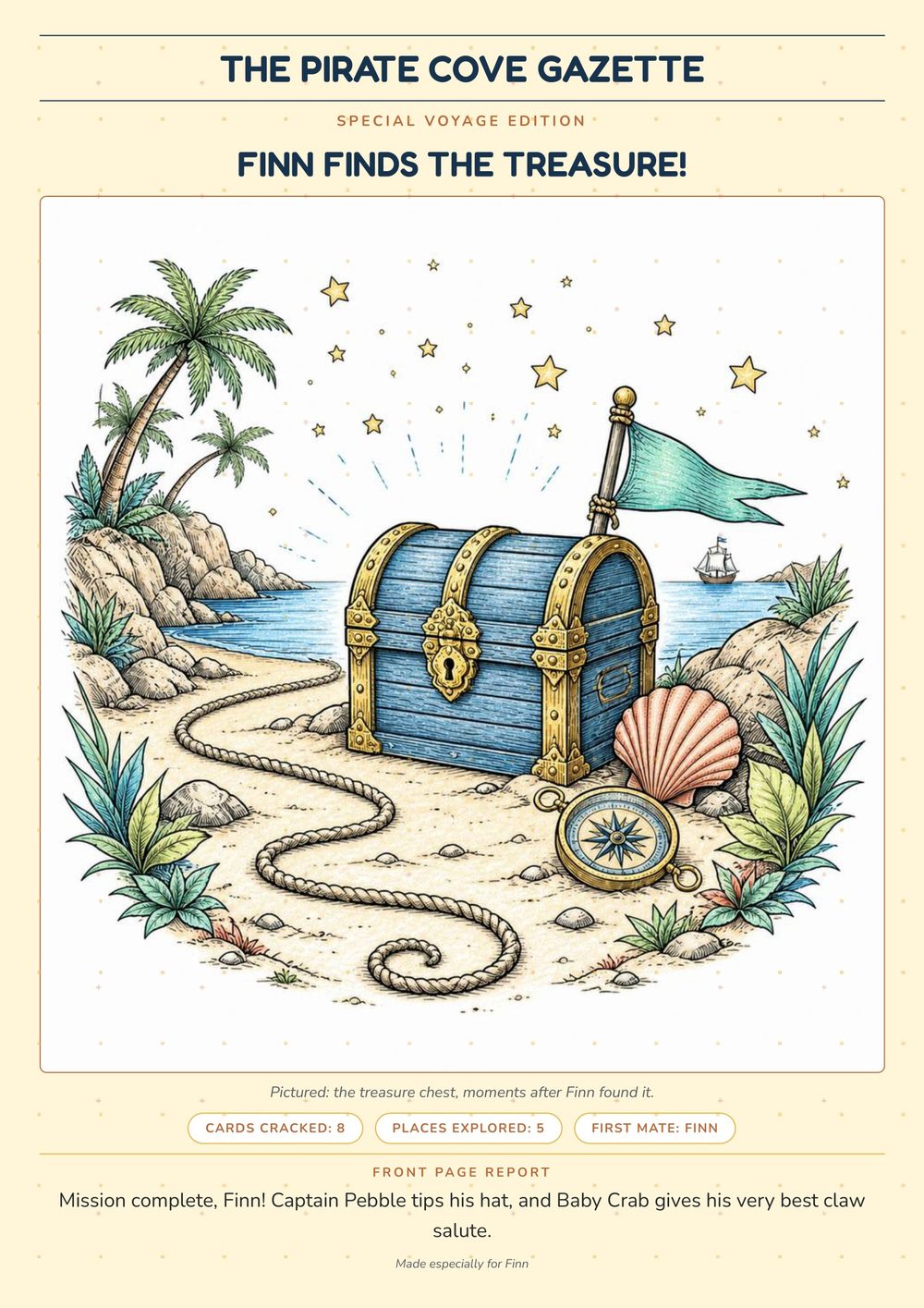
A pirate treasure hunt at home turns familiar furniture into island stops on the way to the captain's lost treasure. Choose four or five home spots, draw a simple island map, and arrange clues that send the child from one stop to the next. Use a friendly crew, picture clues for ages 4–5, and short pirate riddles for ages 6–9. The sample pages further down come from two Quest Tales PDFs: nine sheets for age 5, and four sheets for age 8, The Friendly Treasure Map, where the same kind of furniture becomes the stops of Captain Pebble's scattered trail and every clue card before the finale carries one letter of the secret word.
Quick Answer
- Set the story around a friendly crew searching for the captain's treasure.
- Choose four or five reachable furniture spots for the island.
- Use picture cards for ages 4–5 or riddles for ages 6–9.
- Gather paper, a printer, scissors, and a gift; add a pencil for a DIY map.
- Hand the first clue to the child yourself and let the crew set the pace.
Set the Scene With a One-Minute Introduction
Keep your introduction to about a minute. Tell the child that a friendly captain left treasure somewhere on this home island, and the crew has a trail of directions. The child is joining that crew. Hand over the first clue, then let the first destination carry the story forward.
The pirate voice can be light. Use a captain, a crew, and an island without filling every sentence with unusual spellings. Say the place names clearly when helping with a clue. A familiar sofa should still look and sound like a sofa, even if your map calls it Cushion Cove.
Ordinary clothes are fine, and a costume that already lives in the house is welcome. The story does not depend on a hat, a sword, or a ship model. A sheet of paper and the furniture you picked are the whole set.
Draw a Home Island Map
On paper, sketch four or five furniture pictures with space between them. You might use a sofa, bed, dining table, bookshelf, and toy basket. Put the real furniture name below each drawing for your own reference. Add island names only if they make the story clearer. Keep the drawing simple enough that you can match it to the room at a glance.
Decide whether this is the child's map or your private placement map. On the child's version, leave out the gift's exact hiding position. A large mark over the final location would reveal the answer before the clues lead there. Your private copy can include the route order, card numbers, and precise gift spot.
Plan the trail backward from the treasure. Place the last clue at the stop before the gift, then continue backward to the start card in your hand. At each location, hide the card that points to the following place. Avoid stacking several cards at one stop. If your DIY route returns to a place, put its later card there after the child has finished the first visit.
Keep the map close to the real home. All island stops should be indoors, reachable, and on the same safe walking route. Do not send the crew behind heavy furniture or up onto anything.
Eight Original Pirate Clues
These are separate DIY clue choices written for this page. Select the ones that match your furniture and arrange them in your chosen order. Each answer is for your placement list. The child-facing card gets the picture or riddle, without the answer and parent notes.
Picture and One-Line Clues for Ages 4–5
- 1. Sofa, ages 4–5. Picture idea: draw the sofa with cushions shaped like a row of small islands. Optional line: “The crew's next message rests at Cushion Cove.” Place the next card on a sofa seat with one corner visible. Use the sofa's real outline in the drawing.
- 2. Toy basket, ages 4–5. Picture idea: draw the toy basket with a paper sail above its rim. Optional line: “The toy ship carries a captain's message.” Leave the next card on top of the toys. The sail is part of the picture; the basket stays on the floor.
- 3. Dining table, ages 4–5. Picture idea: draw the dining table with a large paper map lying flat on top. Optional line: “The captain left a note at the dinner dock.” Put the next card on a cleared, reachable table edge, away from dishes.
- 4. Bed, ages 4–5. Picture idea: draw the child's bed with a blanket showing simple wave lines. Optional line: “The blanket sea has a message by its pillow.” Tuck the next card beside the pillow within reach from the floor. Keep the blanket flat rather than making a tunnel.
Riddle Clues for Ages 6–9
- 5. Bookshelf, ages 6–9. “The captain's paper fleet stands tall, with spines instead of masts along a wall.” Answer: bookshelf. Leave the next card beside books on a low shelf. Use the visible row of books as the target, without requiring the child to remove them.
- 6. Coat hooks, ages 6–9. “The crew hangs jackets in a row; find the hook that sits down low.” Answer: coat hooks. Place the next card beside a low hook. If the home has only high hooks, choose a different destination for the voyage.
- 7. Front-door mat, ages 6–9. “My flat shore catches shoes at landfall, just inside the entrance hall.” Answer: front-door mat. Use the indoor mat and keep the door closed. Tuck the next card under an edge without lifting or bunching the mat.
- 8. Fridge, ages 6–9. “Our milk sails nowhere, chilled inside; the crew's next note stays on my outside.” Answer: fridge. Stick the next card to the outside at your child's height; nothing needs to go inside.
Make a Treasure Chest Finish
Your treasure chest can be an ordinary box you already have, with a lid the child can lift easily. You can also use the wrapped gift by itself. Pick the package after you know the final location, or choose the location around the package's size. Keep it on a stable, reachable surface.
Place a DIY finish sheet with the gift. Write a brief ending saying the captain's treasure has been found and the crew's voyage is complete. If several children are playing, gather everyone before reading it. Decide beforehand who receives the gift and explain that arrangement before the first clue.
If the finish shares a location with an earlier stop, hold the treasure back until that visit is over. You can place it while the crew reads the next card elsewhere. Keep your route list nearby so you do not accidentally replace a clue that still needs to be found.
Skip Flames and Awkward Hiding Places
Use plain paper for your map. Draw a wavy border if you want an old-map look. Skip real candles and burned paper edges, especially with children nearby. Put scissors away after you cut the cards, and keep any decorative string off the walking route.
The crew should walk between stops. Keep cards away from moving parts like recliner levers or drawer slides, and off the high shelves. After the treasure is opened, collect the remaining cards and remove any tape from the island stops.
Sample Pages


See the Pirates quest on the main page
Questions
Can I use this pirate hunt for one child or a party?
These DIY ideas can be arranged as a trail for one child or a shared route for a party group. For a group, keep the crew together and rotate who carries each clue.
What ages are the pirate clues for?
The picture examples are labeled for ages 4–5, and the riddles for ages 6–9. Choose the format that suits the child and read any part aloud when needed. Quest Tales is for ages 4–9.
How long should a pirate treasure hunt take?
The time depends on the clues, route, and pauses. Choose your stops before starting and keep the final gift ready. If you need a shorter hunt, remove a middle stop and adjust the preceding clue before play.
What supplies do I need for a pirate hunt?
For the printed DIY version, use a printer, plain paper, scissors, and a gift at reachable home spots. A pencil is useful for a hand-drawn map. Costumes, a toy ship, and a wooden chest are optional.