Ideas & How-Tos
Rainy Day Treasure Hunt: Turn a Wet Afternoon Into an Indoor Trail
A rainy day treasure hunt is a clue trail through your own home, written for an afternoon when going outside has stopped being an option. Choose four or five spots the child already knows, decide the order, and hand over a first card that points to the next one. Pictures carry the trail for ages 4–5; short riddles suit ages 6–9.
Quick Answer
- Pick four or five indoor spots and fix their order before you write a single card.
- Let the weather be the reason for the story: a parcel that could not be delivered, a visitor who came in out of the wet.
- Use picture clues for ages 4–5 and riddles for ages 6–9.
- Keep one active card at each stop and carry the used ones with you.
- Finish somewhere the child has not already searched, and keep the ending small.
The Rain Does Half the Work for You
Most rainy day lists offer crafts and baking: activities that hold a child in one chair. A clue trail does the opposite. It uses the restlessness that comes with being stuck indoors and gives it somewhere to go, one room at a time.
The weather also hands you a story without any invention. Something arrived in the rain and had to be left inside. A visitor shook off an umbrella and wandered through the house. Pick one reason and carry it to the ending rather than adding a new character at every stop.
It helps to know which game you are running. A checklist hunt asks the child to find ten listed objects in any order. A trail has a sequence: each card names one place, and the next card is waiting there. For a wet afternoon the trail is the better shape, because it keeps the child moving instead of scanning a room.
Plan the Route Before You Write a Single Card
Walk the route first at your child's height. Four or five spots are plenty, and the ones a small explorer can reach without climbing are the ones worth using. On a wet day the windows are the most interesting objects in the house, so put at least one stop where the rain is visible.
Leave out the corner where wet coats and umbrellas are dripping. Paper and puddles do not mix, and a soaked card is the one part of the trail you cannot repair mid-game.
Keep a private list as you plan, one line per stop: which card, which place it sends the child to, and exactly where the next card sits when they get there. The opening card never gets hidden. It stays in your hand. And the card waiting at the window has to send the child somewhere else entirely, which is the easiest thing in the world to get backwards when you are holding six cards at once.
Put the finish in position before anything else, then work backwards along the route laying cards as you go. Once everything is placed, play the trail yourself once, out loud. Two minutes of that catches the card that points at the room you are standing in, and the riddle that fits the kitchen table as neatly as the one you meant. Where a clue could name two places, add a detail only your own furniture has: a colour, a chip in the paint, the toy that always sits there.
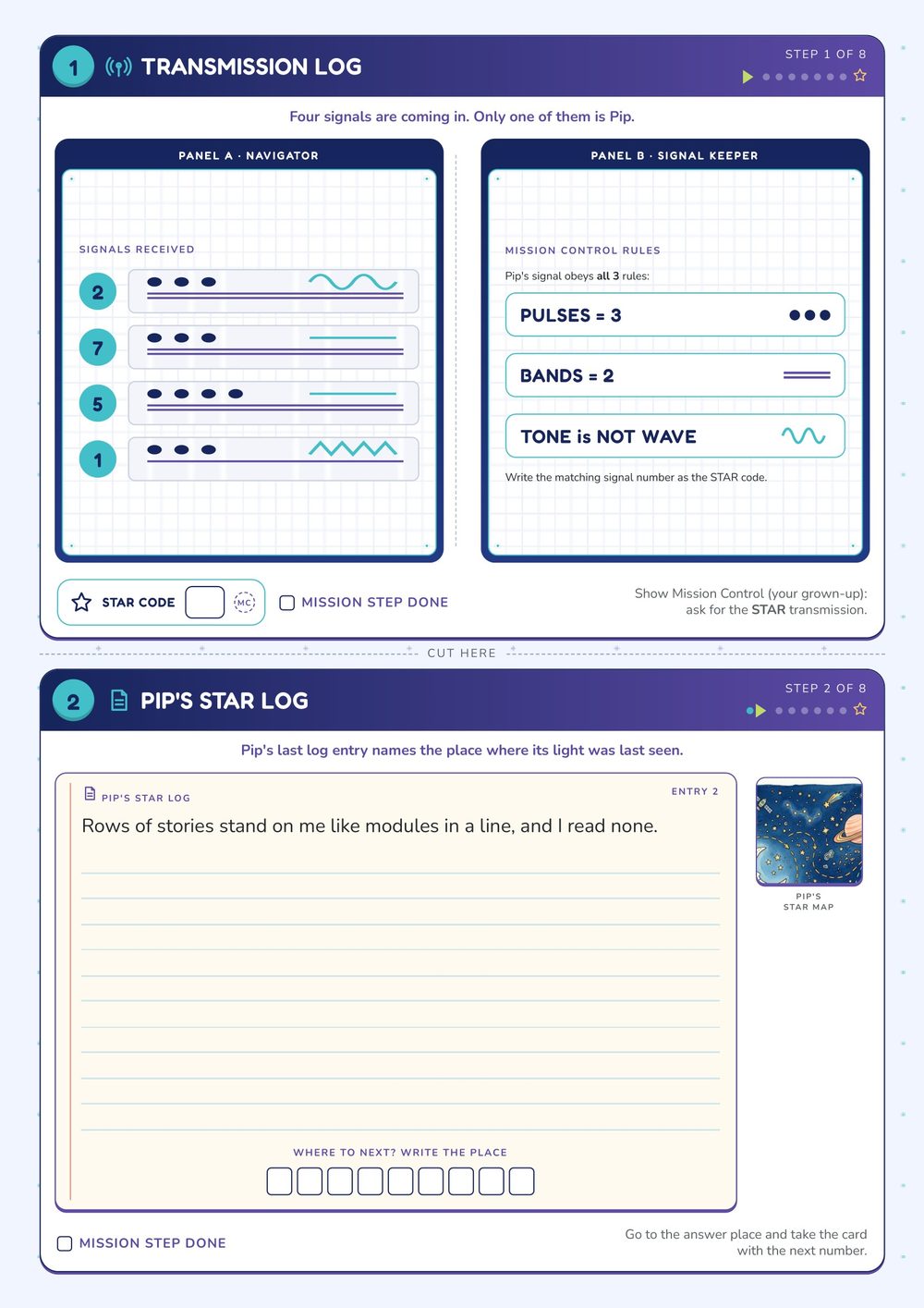
With a Quest Tales PDF the route arrives already built: the parent picks four or five real spots at home, and the quest comes back with 5–8 connected clues plus a placement map for the parent. That works out as five or six stops for ages 4–5 and seven or eight for ages 6–9.
Eight Rainy Day Clues to Choose From
Eight separate DIY options, written for this page around things a wet day puts in front of you. Take the ones your home can supply and drop them into your own order; the numbering is for reading, not for playing. Only the picture or the riddle goes on the child's card. The answer and the placement note stay on your route list.
Picture and One-Line Clues for Ages 4–5
- 1. Window, ages 4–5. Picture idea: draw a window with several long raindrops running down the glass and a fat cloud above it. Optional line: “The raindrops are having a race, and one of them left you something.” Put the next card on the sill and weigh it down with a small toy so it cannot slide off.
- 2. Rain boots, ages 4–5. Picture idea: draw the child's boots standing side by side with a puddle in front of them. Optional line: “Your boots are waiting for a puddle. Something is waiting inside them.” Tuck the card into the top of one boot with a corner left showing.
- 3. Basket of clean laundry, ages 4–5. Picture idea: draw a basket with folded towels stacked above the rim. Optional line: “A paper towel joined the soft pile by mistake.” Lay the card flat on top of the folded pile, so nothing needs unfolding to find it.
- 4. Umbrella left open to dry, ages 4–5. Picture idea: draw an open umbrella standing on the floor with one drip beneath it. Optional line: “The umbrella is drying, and it is keeping something underneath.” Slide the card under the edge where the child can see a corner. Use an umbrella that is already open to dry rather than opening one indoors for the game.
Riddle Clues for Ages 6–9
Rhyme is the mechanic that lands earliest, so for cards you write yourself start with rhyme and add wordplay only once rhyme has become easy. A Quest Tales PDF climbs the same ladder: at age 6 each card names or describes its place in a sentence, and from age 7 the word clues are riddles with one card printed upside down. In most themes a scrambled word joins at 7 and a number code with its decoder at 8. In the Space mission for ages 7–9 a single card holds a riddle at 7, a scrambled word at 8 and the number code at 9, so a Space quest never has both.
- 5. Radiator, ages 6–9. “I hold no fire and I burn no log, but I dry your socks on a day of fog.” Answer: the radiator. Check the temperature with your own hand before the game; if the heating is running warm, lay the card on the floor in front of it instead.
- 6. Mug shelf, ages 6–9. “We stand in a row with our handles all one way, and we fill up with cocoa on a grey wet day.” Answer: the mug shelf. Place the card beside the mugs and well away from the kettle, and choose a different clue if the shelf is above your child's reach.
- 7. Houseplant on the sill, ages 6–9. “I watch the rain from morning to night, but the drink that I get comes from a can, not the sky.” Answer: the houseplant. Prop the card against the pot rather than tucking it into the soil.
- 8. Hallway mirror, ages 6–9. “Come stand in front of me, and somebody stares; they wear your own jumper and copy your glares.” Answer: the hallway mirror. Tuck the card into a corner of the frame or leave it on the shelf underneath.
Give the Finish Something Quiet
A rainy afternoon does not need a parcel at the end of it. The finish can be the plan for the rest of the day, made visible: a board game already set out on the floor, popcorn measured into a bowl beside the remote, a new book propped on a cushion. The child sees the ending and knows what happens next, which is most of what a finish has to do.
Make the last card different from the travelling ones. Say plainly that the trail is over and point at what is waiting. There is no need to add one more puzzle after the ending. The arrival is the reward, and stretching it usually costs you the moment.
When the Trail Ends and the Rain Does Not
Gather the used cards as you go, so only the current one is waiting at each stop. That matters most if your route returns to a place it has already visited.
If the weather is still going when the gift is open, hand the pencil over. A child who has just followed eight clues usually wants to write some. Their trail will be shorter, the riddles will be strange, and following it is the second half of the afternoon. Keep both sets of cards in an envelope afterwards; the next wet day arrives sooner than you think, and a route that is already drawn takes ten minutes to change instead of an hour to invent.
Sample Pages


Questions
What makes a good rainy day treasure hunt for a four-year-old?
Keep it to four or five familiar spots and use pictures rather than words. Read each card aloud, walk with the child, and let them lift the next card themselves. A short trail that ends while the child still wants more is better than a long one.
How long does a rainy day treasure hunt take?
There is no fixed playing time. It depends on the route, the clues, and how long the child studies each card. Plan the trail as one part of the afternoon rather than the whole of it.
What can I use as the prize if there is nothing in the house?
On a weekday the finish is often a plan rather than a parcel. A board game set out ready to play, a film with popcorn measured into a bowl, or a book waiting on a cushion all work as an ending the child can see.
Can I run the same hunt again on the next rainy day?
Yes. Keep the cards, then change the order of the stops and swap two clues for new ones. The route feels different even when several cards are familiar, and a child who has played once often wants to hide a trail for you.